The Port State Control’s (PSC) 2025 Concentrated Inspection Campaign (CIC) is fast approaching. Scheduled to take place from September 1st to November 30th, 2025, the campaign will place full focus on ballast water management – ensuring vessels comply with the requirements of the Ballast Water Management Convention.
Ensure your vessel is always inspection-ready and with SERTICA Logbook, providing secure and compliant recordkeeping.
Understanding PSC CIC 2025 and what it means for ship operators
Every year, PSC authorities conduct Concentrated Inspection Campaigns (CICs) to assess compliance with key international regulations. These focused inspections typically run for a defined period and involve targeted questionnaires and increased scrutiny during routine PSC inspections.
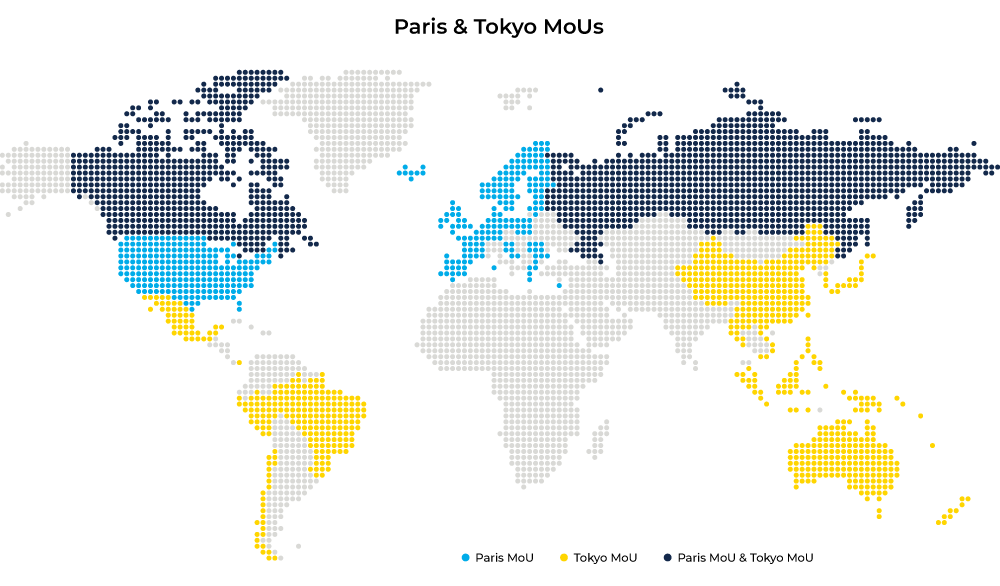
These campaigns are coordinated efforts between member states under regional MoUs, like the Paris and Tokyo MoUs, to ensure a consistent approach to maritime safety and environmental protection.
For 2025, the focus of the CIC is Ballast Water Management compliance, making it essential for operators to ensure that all procedures and documentation related to ballast water are fully aligned with the IMO Ballast Water Management (BWM) Convention.
How it impacts your next Port State Control inspection
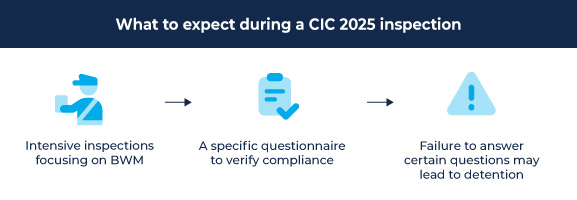
The 2025 CIC means that during routine Port State Control inspections between September 1st and November 30th, 2025, shipowners and operators should expect:
- Increased inspection frequency at ports covered by the Paris and Tokyo MoUs.
- A targeted questionnaire focused on ballast water compliance.
- Closer examination of crew familiarity, ballast system operations, and recordkeeping practices.
Among the most important documents is the Ballast Water Record Book (BWRB). As a result, having an accessible, error-proof, and inspection-ready log system is not only practical but essential for compliance in 2025.
What is the Ballast Water Management (BWM) Convention?
Adopted by the IMO, the BWM Convention aims to prevent the spread of harmful aquatic organisms through ballast water discharge. It requires ships to manage and treat ballast water to reduce environmental risks when entering new ecosystems.
Ships under contracting parties to the BWM Convention must comply when using ballast water on international voyages.
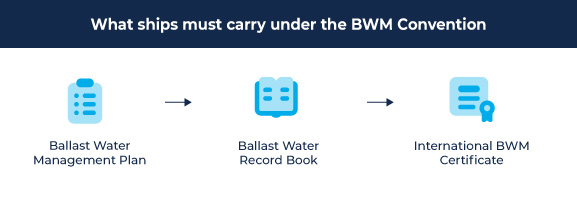
Compliance is demonstrated through a ship-specific plan, accurate recordkeeping, and ships of 400 GT or above must carry a certificate issued by or on behalf of the Flag State. Get a full overview of the Flag State approvals of the SERTICA Logbook.
How it impacts your next Port State Control inspection
From 1 February 2025, important amendments under MEPC 82 have reshaped ballast water compliance. These include:
- A new, more structured format for the Ballast Water Record Book (BWRB).
- Requirements to log Ballast Water Management System (BWMS) maintenance activities and any bypass events.
- Increased focus on documentation.
In addition, through resolutions MEPC.372(80) and MEPC.383(81), further amendments to the BWM Convention, enter into force in October 2025:
- Electronic Ballast Water Record Books must be approved by the vessel’s flag state.
- A ship-specific declaration must be kept onboard, confirming adherence to IMO standards.
- Vessels already using electronic logs must review and ensure their systems meet these new criteria.
Questionnaire for a Port State Control inspection during PSC CIC 2025
On the 1st of August 2025, the Tokyo and Paris Memoranda of Understanding (MoU) published the questionnaire for the upcoming CIC. Port State Control Officers will use the questionnaire to assess that the BWM requirements in the respective areas are met.
| No. | Questions | Yes | No | N/A | Detention |
|---|---|---|---|---|---|
| 1* | Is a valid International Ballast Water Management Certificate (IBWMC) on board? (01136 - BWM 2004 / Reg. E-2) | ||||
| 2* | Is the approved Ballast Water Management Plan (BWMP) on board? (14801 - BWM 2004 / Reg. B-1) | ||||
| 3* | Is the BWMP up to date to reflect the applicable requirements to manage Ballast Water as required by the Convention? (14801 - BWM 2004 / Reg. B-1) | ||||
| 4* | Are officers and crew familiar with their duties in the implementation of the BWMP? (14806 - BWM 2004 / Reg.B-6) | ||||
| 5* | Is the Ballast Water Management System (BWMS) approved by the Administration/Organization, as appropriate? (14812 – BWM 2004 / Reg. D-3 or BWMS Code) | ||||
| 6* | Is the BWMS operational? (14811 - BWM 2004 / Reg. D-2 or BWMS Code Section 4) | ||||
| 7* | Was the Ballast Water managed according to the BWMP? (14813 - BWM 2004 / Reg. B-1) | N/A | |||
| 8* | Is the Ballast Water Record Book (BWRB) properly filled including exemptions if granted? (14802- BWM 2004 / Reg. B-2 & Reg. A-4.4) | N/A | |||
| 9* | Is the crew managing Ballast Water sediments in accordance with the BWMP? (14805 - BWM 2004 / Reg. B-5) | ||||
| 10* | If an exemption has been granted, are the conditions of exemption implemented? (14809 – BWM 2004 / Reg. A-4) |
View the entire questionnaire for Port State Control inspections during PSC CIC 2025. Paris MoU Press release | Joint Concentrated Inspection Campaign on Ballast Water Management.
Requirements for Ballast Water Management compliance
To determine whether vessels meet the requirements of the BWM Convention, PSC officers will assess the following during inspections:
- Proper certification for the BWM Convention, approved by the flag state.
- Approval and update of the Ballast Water Management Plan (BWMP).
- Crew familiarization with the implementation of the BWMP.
- Approval and functioning of the Ballast Water Management System.
- Records of Ballast Water Record Book.
- Ballast water sediment management.
- If any, valid exemptions.
Most common Ballast Water Management compliance deficiencies
The most common deficiencies related to BWM compliance often involve a combination of documentation issues, procedural errors, and system malfunctions. These are typically:
-
Ballast Water Record Book
Use of outdated versions, missing or inconsistent entries, and lack of flag state approval for electronic record books. -
Ballast Water Management System
Not following manufacturer specifications, untreated ballast water mixing with treated water, contamination from the tanks themselves, system malfunctions, and failure to report malfunctions. -
Ballast Water Management Plan
Outdated or missing information, lack of crew training and knowledge, and no one assigned to oversee the implementation of the BWMP.
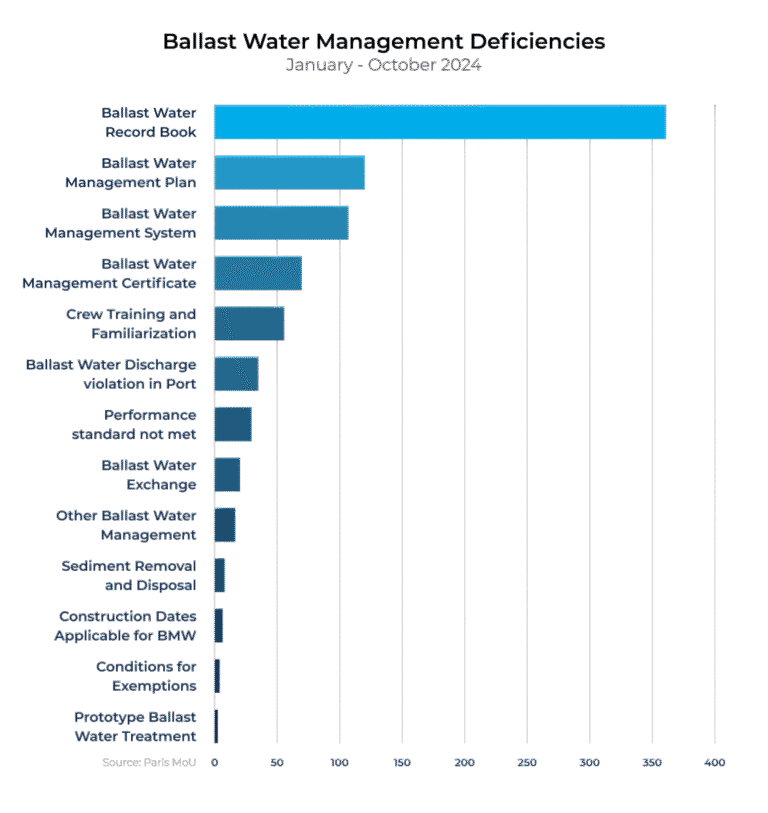
Based on data from Paris MoU’s inspection results, the most common deficiencies are in the Ballast Water Record Book:
Importance of the Ballast Water Record Book
In accordance with the BWM Convention, all applicable ships must carry a Ballast Water Record Book and perform ballast water management operations according to regulated standards. The BWRB is a critical document during inspections, and its accuracy can determine compliance outcomes.
Digitalize your Ballast Water Record Book
Ensure compliance with IMO and flag state requirements by replacing paper logs with the SERTICA Ballast Record Book. Record all ballast operations digitally – from intake and circulation to discharge and exceptional events – with predefined steps and validation that reduce errors.
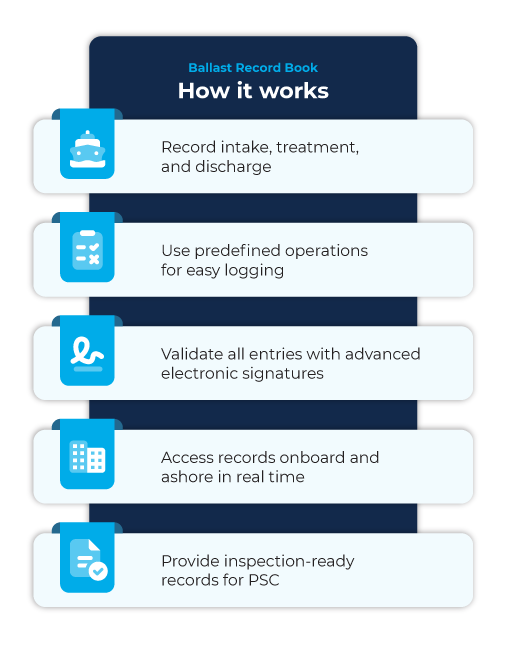
Advanced electronic signatures and anti-tampering measures secure data integrity, while audit-ready records simplify inspections, ease the crew’s workload, and help prevent the spread of microorganisms. Accessible both onboard and ashore, SERTICA improves compliance, data quality, and environmental protection.
Learn how to digitalize your logbooks, ensure accurate data entries, and transform the data into actionable insights to improve performance
Webinar on demand
Turn Data into value with Logbook
Learn how to digitalize logbooks in SERTICA, prevent data manipulation, and enhance operational performance with reliable electronic records.
See more
Prepare for your next Port State Control inspection
Crews already handle a growing range of responsibilities – from voyage planning and emissions tracking to safety and compliance. The upcoming PSC CIC on ballast water adds another layer of complexity.
SERTICA Logbook provides a structured, compliant, and user-friendly way to manage ballast water records. It enables shipowners and operators to:
- Ensure compliance with MARPOL, IMO, and flag state requirements through validated log entries.
- Maintain full traceability with user identification, timestamps, and audit logging
- Simplify inspections by offering instant access to records onboard and ashore
- Increase efficiency by replacing manual entries with digital workflows
- Streamline operations via integration through API, allowing seamless workflows across systems.
Implementing MDM is not a simple task, especially when data is highly fragmented. However, the long-term benefits of a centrally controlled data repository far outweigh the challenges.
It can also be a combination, so only widely used equipment is control centrally and more unique equipment is converted specifically for each ship.
Stay ahead of CICs, support your crew, and simplify compliance
Guide
Get ready for port state control
Be prepared for Port State Control inspections with insights on compliance, documentation, and digital tools in SERTICA to avoid detentions and ensure smooth operations.
Read More